🤓 Smarty Pants
Red Light: What It Is and What It Isn't
Think all light is created equal? Not even close.
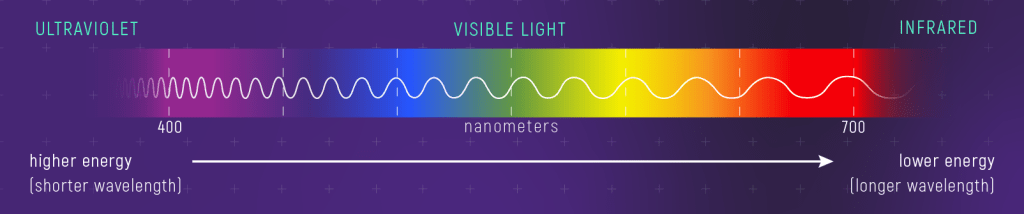
When we talk about light, we're really talking about wavelengths — and different wavelengths do completely different things to your body. The light we can see (the visible spectrum) runs from deep blues and purples on one end to oranges and reds on the other. But there's a whole world of light we can't see.
The Short Stuff (Blues & UV)
Short wavelengths pack a punch. UV light—the stuff just beyond what we can see on the blue/violet end—is what's called ionising radiation. That means it carries enough energy to damage your DNA (if you don't work in harmony with it and create a solar callus).
This is why, if you spend too much time under the midday sun, your skin turns pink and you can burn. It's your body's internal warning system saying you've had enough and it's time to seek shade. And what's your skin actually doing (as it's turning pink)? It's blocking the UV rays from being absorbed — so technically, this is a healthy protective response.
So remember, UV isn't bad. We need UV rays to create nitric oxide (see last week's newsletter for a refresher) and the incredible hormone, Vitamin D.
The Long Stuff (Reds & Infrared)
Long wavelengths—red light and infrared—are completely different. They're non-ionising, meaning they can't damage your DNA. Instead of being blocked at your skin like UV, these gentle wavelengths actually pass through your whole body, scattering around inside you like friendly little photons bouncing through your organs.
And here's the magic: red and infrared light are absorbed by the water surrounding your mitochondria, helping those tiny energy factories work better and produce more ATP. They're not just harmless—they're healing.
So when you're standing in morning sunlight (which is high in red and infrared light and low in UV), you're getting the complete package: visible light your eyes can see, plus all that invisible infrared soaking deep into your cells doing repair work you can't see but your body desperately needs.
Nature's always got the full recipe — all in the right doses at the right time.
🔥 Deep Dive DL;TL
Affecting Health With Light: Good vs Bad
What if I told you that lowering your blood sugar spike by 27% didn’t require fasting, supplements, or medication… but simply three minutes of the right light on your skin? Or how about improving your eye sight, reducing chronic disease systems or lengthening your life? All possible too.
Dr. Glen Jeffery isn't your typical neuroscientist. He's a Professor of Neuroscience at University College London with over 30 years studying how light affects our biology at the cellular level. His recent work on red and infrared light therapy has completely transformed how we think about mitochondrial health, aging, and disease prevention. Today, we're diving into his fascinating conversation with Andrew Huberman.
The Harmful Sun Myth Shattered
For decades we've been warned to avoid the sun, slather on sunscreen, and hide indoors. But the data tells a radically different story.
Large-scale studies tracked tens of thousands of people and found something extraordinary: people with the GREATEST sun exposure had significantly lower all-cause mortality. They're living longer, healthier lives. Dr. Richard Weller, a dermatologist from Edinburgh who's courageously re-examining decades of sun-fear messaging, puts it plainly: "All cause mortality is lower in people that get a lot of sunlight."
And melanoma — the cancer we’ve been taught to blame on the sun? The data flips that story upside down. The deadliest melanomas often appear on areas that never see sunlight (soles of feet, between toes), and the people who get them tend to have low vitamin D, not high. If sunlight were causing their cancer, the opposite would be true.
As Dr. Jeffery explains: “If skin cancer was directly related to sunlight, we should find very high vitamin D levels in those patients. In fact, we find the opposite.”
The real takeaway? Avoid sunburn — that’s when UV becomes damaging. But don’t fear the sun itself. Your body needs it, your mitochondria depend on it, and the people getting the most of it are consistently living the longest.
Red Light: Your Mitochondrial Fountain of Youth
Dr. Jeffery's research reveals red and infrared light can improve a staggering range of health issues by supporting your mitochondria. His team proved shining red light on just a small patch of back (about 10cm x 15cm) reduced blood glucose spikes by over 20%.
Why? Because when mitochondria are stimulated with long-wavelength light, they burn through glucose more efficiently—so the spike never gets the chance to climb.
Daily 3-minute exposures slowed age-related vision loss and in Parkinson's patients, shining red light on the abdomen significantly reduced symptoms—even though the disease originates deep in the brain.
The magic? Long wavelength light penetrates everything—your clothes (even six layers!), your skin, your bones, even your skull. It scatters throughout your body, reaching your mitochondria wherever they are.
Mitochondria: Not What You Think
Forget thinking of mitochondria as isolated battery packs. They're a community. Think of them like a neighbourhood group chat—stimulate one and the message spreads everywhere. Dr. Jeffery explains: "Mitochondria at 9am is not mitochondria at 4pm"—they perform different jobs at different times of day. And this means, they need different light too.
The Double Hit
Here's where modern buildings are giving your mitochondria a one-two punch. First, cheap LEDs get installed—zero red or infrared wavelengths, just blue spikes. Then, infrared-blocking glass gets fitted to every window. You're now stuck in an environment completely stripped of the wavelengths your mitochondria desperately need. No red light from overhead. No infrared penetrating through windows. It's a mitochondrial disaster zone masquerading as an energy-efficient building.
The effects? Mice raised under LED lighting gain weight, develop fatty livers, smaller organs, abnormal sperm morphology, anxiety-like behaviour, and shortened lifespans—all while eating the exact same food as mice under full-spectrum light.
Even more concerning? Western European lifespan was steadily climbing until around 2010—when it plateaued. This coincides perfectly with widespread LED adoption. Dr. Jeffery calls this combination "possibly as serious as asbestos" for public health. Your workplace could very well be slowly starving your cells of the light they need and evolved under for billions of years.
The Critical Takeaway: Start Early
Red light therapy works best as prevention, not rescue. Once disease sets in and mitochondria are severely damaged, they're much harder to save. Dr. Jeffery's research shows adults over 40 get the biggest vision improvements from red light therapy, but that's because younger people's mitochondria are still healthy.
The message? Don't wait until you're sick. Get outside in natural sunlight (which contains the full spectrum), consider replacing LED bulbs with incandescent where possible, and if you work indoors under LEDs all day, supplement with red light exposure or simply get outside during lunch breaks.
Your mitochondria have been waiting billions of years for this conversation. They're listening—every day, you get to choose what you feed them.
☀️ Sandy's Sunshine
Your Office Upgrade Plan
Stuck under fluorescent LEDs all day? Here's how to fight back against the double hit.
Window Warriors: If you can't open windows, position your desk near one. Even filtered sunlight beats pure LED exposure. Better yet, crack that window open—even a tiny gap lets infrared wavelengths scatter into your space.
Lunch revolution: Ten minutes outdoors restores the light your cells have been deprived of all morning.
Light Swaps: Swap out your desk lamp or bring one in. Choose incandescent or halogen over LED to rebalance your spectrum.
Red Light Ritual: Consider a small red light device (670nm+) for 3-minute sessions at your desk. Dr. Jeffery's research shows this is enough to flip that 5-day biological switch.
Your biology was built for sunlight — not office LEDs.
🔢 Number Crunch
6: The number of layers of clothing red / infrared light can penetrate through.
And that's a wrap my friends! I hope you have a beautiful week ahead and if you have any questions, comments or feedback, please hit reply. I read every email.
P.S What did you think of today's newsletter? I'd love to know.