Welcome to The Rise - your weekly dose of circadian sunshine, decentralised health wisdom, and actionable tips to help you live healthier, stronger, and more empowered.
This week we discovered the best time to exercise, how chronic melatonin use wrecks hearts, get your optimal 24 hour circadian day plan and how your mitochondria are solar powered — all reminding us that your body's ancient wisdom beats modern medicine's newest hacks.
Have suggestions? Or something you’d like to see here? Help me better serve this vibrant community of health rebels, hit reply and send me your feedback.
Much love and sunshine, ☀️ Sandy xx
P.S. Don't keep me a secret. Share this email with someone who'd find it helpful. Your friends can sign up here.
Issue # 94 • 16 November 2025
☀️ Rise Report
Want a Healthier Heart? Exercise at This Hour
Here's something your fitness tracker isn't telling you: when you exercise might matter just as much as whether you exercise.
An April 2025 study published in Medicine & Science in Sports & Exercise found that people who exercised earlier in the day, and at the same time each day, experienced the greatest cardiovascular benefits, regardless of activity type or workout length.
The magic isn't about becoming a 5am workout warrior (thank goodness). It's about consistency. The study's author noted that "the timing and reproducibility of the activity are working with our intrinsic circadian clock system to maintain health."
And if you wanted more proof, a 2023 study in Obesity concluded that exercise between 7am and 9 am was linked to a lower body mass index whilst another study published in Vascular Health and Risk Management suggested that working out at 7 am could improve blood pressure.
Your body was designed to work with rhythms, not against them. Pick a time, show up consistently, and let your circadian system do what it's been perfecting since, well, forever. So, remember when our grandparents got up early, went for a walk and did their chores at the same time every day? We need to do more of that.
"The key is to do what's most likely to work consistently for you."
The Melatonin Plot Twist Nobody Saw Coming
Now, that we've discovered something that's good for our heart, here's something that's not so good.
Think taking melatonin to improve your sleep, which is good for your heart, is a good idea? Maybe not. A massive new study found that adults with chronic insomnia who used melatonin for a year or longer faced a staggering 90% higher risk of developing heart failure within five years compared to non-users. That's nearly double the risk.
The data, presented on 3 November at the American Heart Association’s Scientific Sessions 2025, followed more than 130,000 adults diagnosed with insomnia. Among those who took melatonin for over a year, 4.6% developed heart failure (vs 2.7% of non-users). Melatonin users were also 3 times more likely to be hospitalised for heart failure and had almost double the risk of death from any cause.
The takeaway? Your sleep problems aren’t caused by a melatonin deficiency. They’re far more likely a light exposure and circadian disruption problem. And just because something is sold over the counter or marketed as “natural” doesn’t make it safe.
Melatonin is a hormone your body makes with precision. Adding a synthetic version every night interferes with one of your most finely tuned and delicate biological systems, which is essentially tampering with nature itself.
The Media Is Lying to You About What Will Actually Kill You
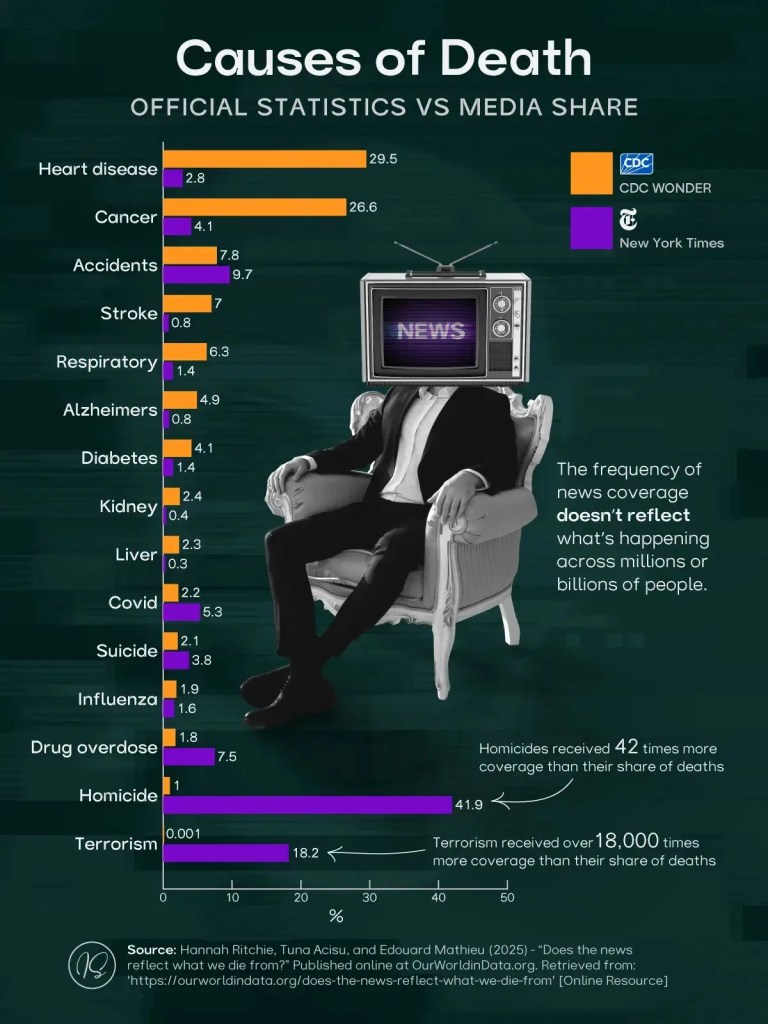
Don't believe everything you see and read! A ground-breaking analysis from OurWorldInData.org just exposed the disturbing gap between what actually kills people and what the media wants us to hear and fear.
Heart disease causes 29.5% of all deaths but receives just 2.8% of media coverage. Cancer kills 26.6% of people yet gets only 4.1% of airtime. Meanwhile, terrorism, responsible for 0.001% of deaths, dominates news coverage at 18.2%. That's 18,000 times more coverage than its actual threat! Whilst homicide gets 42 times more attention than its actual death toll.
The researchers were clear in their findings:
"The frequency of news coverage doesn't reflect what's happening across millions or billions of people."
The media isn't interested in your health, they're interested in your attention. Fear sells. Division controls. Despair destroys. Prevention doesn't make headlines until there's a new fancy pharmaceutical solution to monetise.
The takeaway? The biggest health threats are the preventable, "boring" chronic diseases no one's talking about. Heart disease, cancer, stroke, and diabetes are responsible for over 67% of deaths, yet combined they receive less media attention than homicides. It's time we stop outsourcing our health education to clickbait headlines and start paying attention to what actually matters: the daily choices that prevent the diseases silently killing millions.
In partnership with SaweetWay
❤️ What's Hot
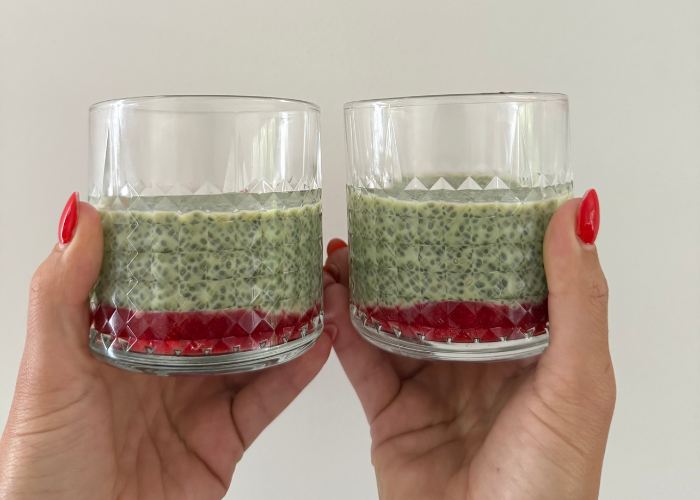
Strawberry, Matcha and Sugar Free - Oh My!
It took my 15 year old daughter to tell me that Strawberry & Matcha was a thing. Turns out, she's onto something delicious.
But then it was my turn to share something with her - keeping your blood sugar steady is a thing too as it reduces inflammation and keeps your energy stable. This Strawberry Matcha Chia Pudding ticks all the boxes: it's healthy, Insta-worthy AND it uses SaweetWay Pure Allulose instead of sugar, so you get all that gorgeous flavour without the spike. Win-win-win!
If you're looking for a simple sugar swap that doesn't taste like a compromise, this one's worth trying. Enjoy 20% off all SaweetWay goodies. Code: THERISE20
🤓 Smarty Pants
Zeitgeber: Your Body's Time Keeper
Zeitgeber is a German word meaning "time giver," and it's the scientific term for any external cue that synchronises your internal biological clock. Think of it as nature's alarm clock - the environmental signals that tell your body what time it is and what it should be doing.
Your body responds to four primary zeitgebers: light, temperature, food, and physical activity.
Each one sends powerful timing signals to your cells, but they're not created equal. Light, specifically morning sunlight, is the master zeitgeber, the conductor of your biological orchestra. It's so dominant that it can override all the others.
When light hits your eyes at dawn, it triggers a cascade of signals to your suprachiasmatic nucleus (your master clock in the brain), which then orchestrates the timing of every biological process in your body—from cortisol awakening to melatonin production 12-16 hours later.
Your body has been designed to respond to these zeitgebers working in harmony - temperature fluctuations (cooler at night, warmer during day), meal timing, physical activity, and light exposure all aligned with each other. But when your zeitgebers are misaligned eg. you're eating dinner at 10pm under LED lights, you're creating circadian chaos. Your hormones don't know whether to prep for sleep or digestion and your immune system doesn't know when to repair.
Your ancestors lived in perfect zeitgeber harmony: sunrise, sunset, seasonal foods, natural temperature cycles, daily movement. It's time for us to tap into that ancestral wisdom and honour our zeitgebers too.
🔥 Deep Dive DL;TL
Why Sunlight Is Your Body's Missing Ingredient
If an astrophysicist spent 50 years studying the edge of the universe and then turned his attention to your mitochondria, you'd want to know what he found.
Bob Fosbury didn't just work on the Hubble Space Telescope, he spent 26 years with it, in addition to publishing papers on everything from solar physics to black holes. When he retired, he could have kept doing astronomy or taken a well earned break. Instead, he asked why nobody connects the dots between stars and cells.
Turns out, those dots form a straight line. This week, we're diving deep into the Sunlight Matters Podcast with Bob Fosbury and breaking down the top 10 AHA moments from this mind-bending conversation.
AHA #1: The 0.7 Magic Number
The activation energy for all metabolism (bacteria to blue whales) is 0.7 electron volts—exactly matching the sun's peak photon output (at 1.6 microns). Life was created (and evolved over 4 billion years) to tune itself precisely to the sun's energy spectrum. I'm sure this wasn't by accident.
AHA #2: Infrared Has Lasting Effects
When you expose your body to infrared light, the benefits last days or weeks—long after the exposure ends. This is the turnover time for generating new proteins and mitochondria. One morning sun session keeps working while you sleep.
AHA #3: LED Lights Damage Mitochondria
White LEDs lack the infrared spectrum your cells need. Astronauts get sick on the space station partly because they live under LEDs without infrared. Now look around - we're all living in a space station to some degree.
AHA #4: Modern Buildings Age You Faster
Infrared-rejecting glass plus LED lights equals metabolic disaster. Fosbury's verdict: "We're making people age faster because you're losing the ability to repair your mechanisms."
AHA #5: Cold Space = Metabolic Superpower
In a 22°C room, only 5% of food energy becomes useful work because your 37°C body struggles to dump waste heat with such a small temperature gap. Step outside under blue sky—the atmosphere reads -40 to -50°C overhead. That massive temperature gradient doubles your metabolic efficiency. Pure thermodynamics.
AHA #6: Lizards Know Better
Infrared light acts like oil in your cellular machinery, tuning up your mitochondrial electron transport. This is what basking lizards instinctively do each morning. Without it? You become like a cave salamander, surviving but not thriving, moving slowly through a long, dim life.
AHA #7: Sunlight = Antibacterial Shield
Skin exposed to sunlight generates reactive oxygen species that kill pathogens on contact. This is why almost nobody caught COVID outdoors.
AHA #8: You're Missing The Third Ingredient
Your body needs three things to thrive: energy source (food), raw materials (nutrients), and cold space to radiate waste heat. Most doctors focus on the first two. Nobody talks about the third. Without cold surroundings to dump excess heat, your metabolism crawls.
AHA #9: Sunscreen Is Useless
Fosbury didn't mince words: "Sunscreen in my view is essentially useless. It's doing the wrong things." Instead of blocking the sun, your skin is designed to use it—generating vitamin D, protective compounds, and the reactive oxygen species that kill pathogens on contact.
AHA #10: The Indoor Light Fix Costs £10
Can't escape LED lights at work? Bob recommends a tungsten oven lamp in an angle poise with a dimmer for your desk—it provides the infrared spectrum LEDs lack. Better yet, get outside for 10-15 minutes of morning sun to recharge your cellular batteries with the exact wavelength they evolved to use.
Bottom Line: Modern life severed our connection to starlight and cold space. The solution isn't expensive, it's reconnecting with the fundamental energy source and temperatures we evolved under and were designed for. Worth the full listen? Absolutely.
☀️ Sandy's Sunshine
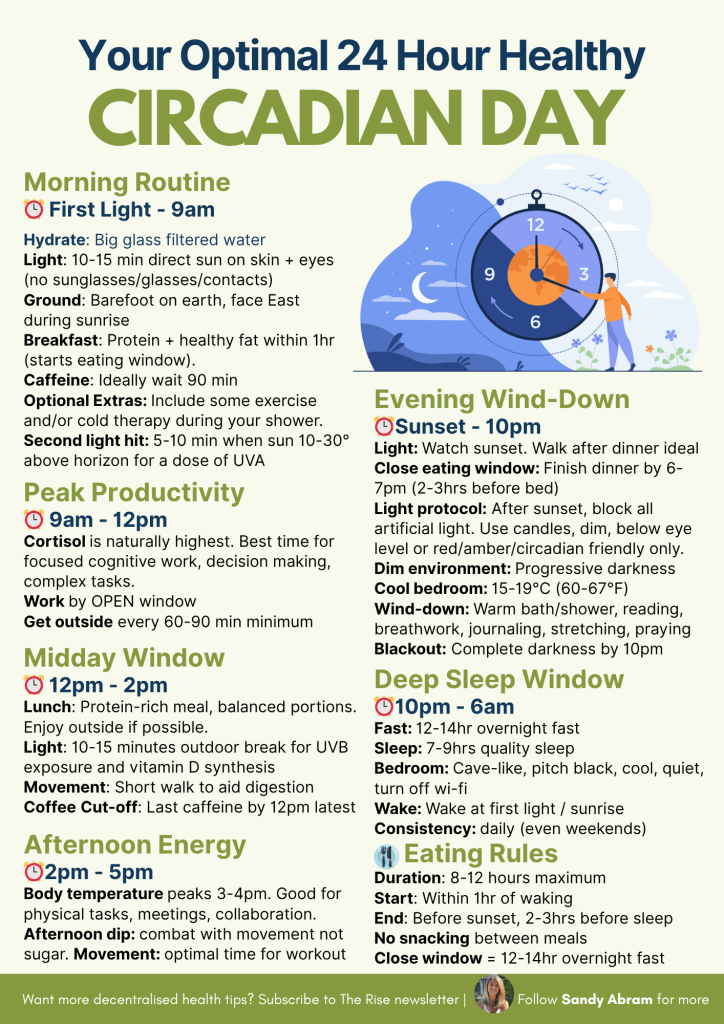
Your Optimal 24 Hour Healthy Circadian Day
Now that you know what zeitgebers are, here's how to actually use them.
After spending the past four years translating research from Satchin Panda, Jack Kruse, Martin Moore-Ede and others, here is your optimal 24 hour circadian day.
But don't worry you don't need to do everything at once. If you're new to the circadian health journey, just master these three and you will be well on your way:
Morning light - Get outside within 30 minutes of waking. 10-15 minutes, no sunglasses, glasses or contacts. This sets your entire day.
Block artificial light after sunset - Use candles, dim lights, or red/amber bulbs only. Your body needs the darkness signal.
12-hour eating window - If you finish dinner by 7pm, don't eat again until 7am. Start there.
Full transparency: Fitting comprehensive circadian protocols onto one page isn't easy and did mean simplification. Your latitude, season, and lifestyle will modify all these timings. So, this is a framework, not a prescription.
And whilst there are debates in circadian circles about optimal timings and specific mechanisms (to breakfast or not to breakfast - that is the question), this guide represents consensus on what work for most people, most of the time. It is here to help you find your rhythm, wherever you are.
Pick your starting point. Revisit monthly. Your circadian rhythm thrives on consistency, not perfection.
🔢 Number Crunch
1 in 4 Australians — are vitamin D deficient, jumping to 36% by winter's end. In the UK it's nearly half, across Europe 40%, the US 41.6% and globally 47.9%. The irony? Vitamin D is free from the sun - we just stopped going outside to get it.
And that's a wrap my friends! I hope you have a beautiful week ahead and if you have any questions, comments or feedback, please hit reply. I read every email. P.S What did you think of today's newsletter? Let me know below ⬇️⬇️⬇️
“This is easily my favourite place,” said the mole. "Because it's so beautiful?" asked the boy. "Because we are all here."
— The Boy, The Mole, The Fox and The Horse by Charlie Mackesy)
🚀 When You're Ready, Here's How I Can Help:
Want your brand in front of thousands of health warriors?
The information in this newsletter is for educational purposes only and not intended as medical advice. Always consult with a healthcare professional for personal health decisions. This post may contain affiliate links, and I may earn a small commission if you make a purchase, at no extra cost to you.